
More code did not remove the cost of coordination
AI made execution capacity easier to access. It did not decide what should enter delivery, freeze scope before review, or prove whether the operation is getting better.
Inventeer is a Productivity Engineering company. We take responsibility for a whole engineering operation or a bounded part delivered as a dedicated cell.
We engineer operations that get better every cycle with the same team: higher quality, less rework, and a ceiling that keeps moving. Every claim we make about it is a number you can check.
Productivity leaks before code, during review, and after delivery
At intake
The request arrives quickly. The argument about what it meant happens later, when changing direction costs more.
In the middle
Scope is discovered inside code review. Senior people spend their time reconstructing decisions that should have been explicit before execution.
Across the cycle
The operation cannot compare one period with the next. Improvement becomes an opinion that disappears under the next deadline.
One accountable operation, not another piece to coordinate
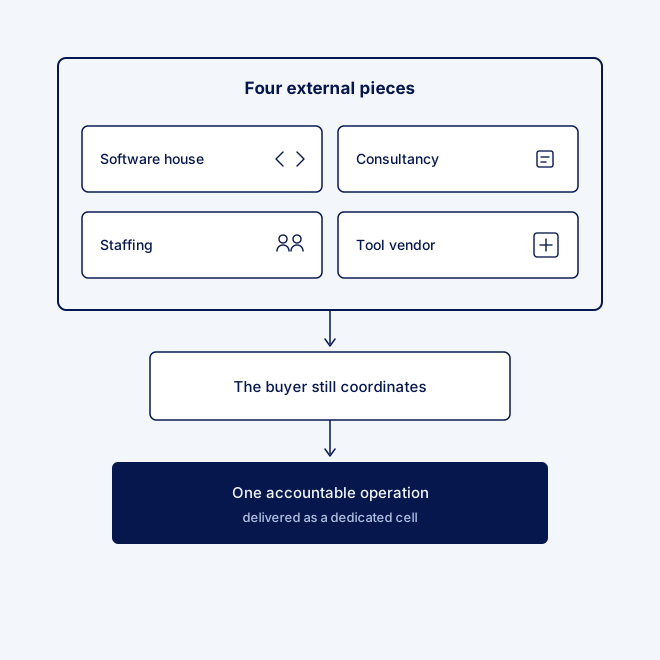
A software house delivers construction. A consultancy delivers recommendations. Staffing delivers people. A tool vendor delivers a tool. Each can be useful. None removes the need for the buyer to coordinate the whole.
Inventeer operates the whole or a bounded part as a dedicated cell. The Inventeer Delivery System is the method the operation runs on. AI works inside that structure, never in place of it.
The work becomes decidable before it becomes expensive
Structured intake
Context, constraints, and acceptance conditions enter together.
Explicit approvals
The operation records what is included, what is excluded, and who approved the decision.
Governed execution
People and AI execute inside the approved boundaries. Human judgment remains responsible for the decision.
Delivery evidence
Completion points back to what was agreed, with artifacts the client can inspect.
This model is useful after coordination becomes the constraint
It fits an active software operation with repeated delivery, real handoffs, and leadership willing to change how work moves. It does not fit a team looking only for advice, extra hands inside its existing process, or AI without governance.
If coordination still works informally and reliably, do not add this operating weight yet.
Choose the question you need answered next
Want the mechanism? See how intake, approvals, execution, and evidence connect.
Want to locate the pressure in your own process? Complete the structured reflection.