On the Business of Building — A Column from Cynthia Jiang
Most companies have one ladder, and it runs through management. Recognizing depth and value creation as real tracks is a structural decision — not a perk.
By the time anyone examines it, the company has quietly decided that the reward for becoming excellent at the work is to stop doing the work.
This gets talked about as a fairness problem. It is really an allocation problem. When the single recognized path to advancement is leadership, everyone who wants to grow, and everyone you most want to keep, eventually arrives at the same choice: manage, or stall. The strongest individual contributors take the promotion, not because they want to lead, but because the alternative is watching their standing and their compensation freeze while less capable peers move past them into management. The choice is rigged, and everyone in it knows.
So you take your best engineer and move them into a role that rewards a completely different skill, and you do it precisely because they were good at the thing you have now asked them to stop doing. Sometimes it works. More often it produces a weaker manager and a lost specialist in a single decision, and neither loss appears on any report. What shows up instead, a quarter or two later, is a gradual thinning of the depth the company can actually draw on, and the slow departure of people who never wanted to manage and could not find another way to be valued.
The more expensive part is what the single ladder teaches everyone who is watching. It says, without ever saying it, that the work itself tops out. That past a certain level the only way the company will keep investing in you is if you stop being the person who does the work and become the person who oversees it. That is a strange thing to tell the people whose work is the reason the company exists, and they hear it clearly, even when no one says it out loud.

The Builders You Lose and the Value You Cannot Place
I have watched good companies lose their most valuable builders exactly this way, and almost never in a dramatic exit. It is quieter than that. The person who has been holding a fragile, critical part of the system together asks, in a review, what growth looks like for them, and the honest answer on offer is a management track they do not want. They stay another year. Then they take a role somewhere that has worked out how to advance a specialist, and the knowledge they were quietly carrying leaves the building with them.
There is a second pattern that costs even more, because it is harder to see. Some people create real value in shapes that fit no standard role. They unblock three teams in a week. They see the expensive mistake before it is made. They turn a vague, stuck problem into something the company can actually act on. They are not managers, and they are not always the deepest specialists, so on an org chart organized around titles and headcount they are difficult to place. Difficult to place becomes difficult to reward, and over a quarter or two they learn the lesson the structure is teaching: the surest way to be recognized here is to acquire reports. And so the company takes one of its rarest kinds of person and trains them to become one of its most common.
None of this requires anyone to act in bad faith. It is the structure doing what an unexamined structure does. A single ladder will always pull every kind of contribution toward the one shape it knows how to reward, regardless of what the company says it values.
“Generate value.
I will generate value for you.”
Three Tracks, Not Three Names for One Ladder
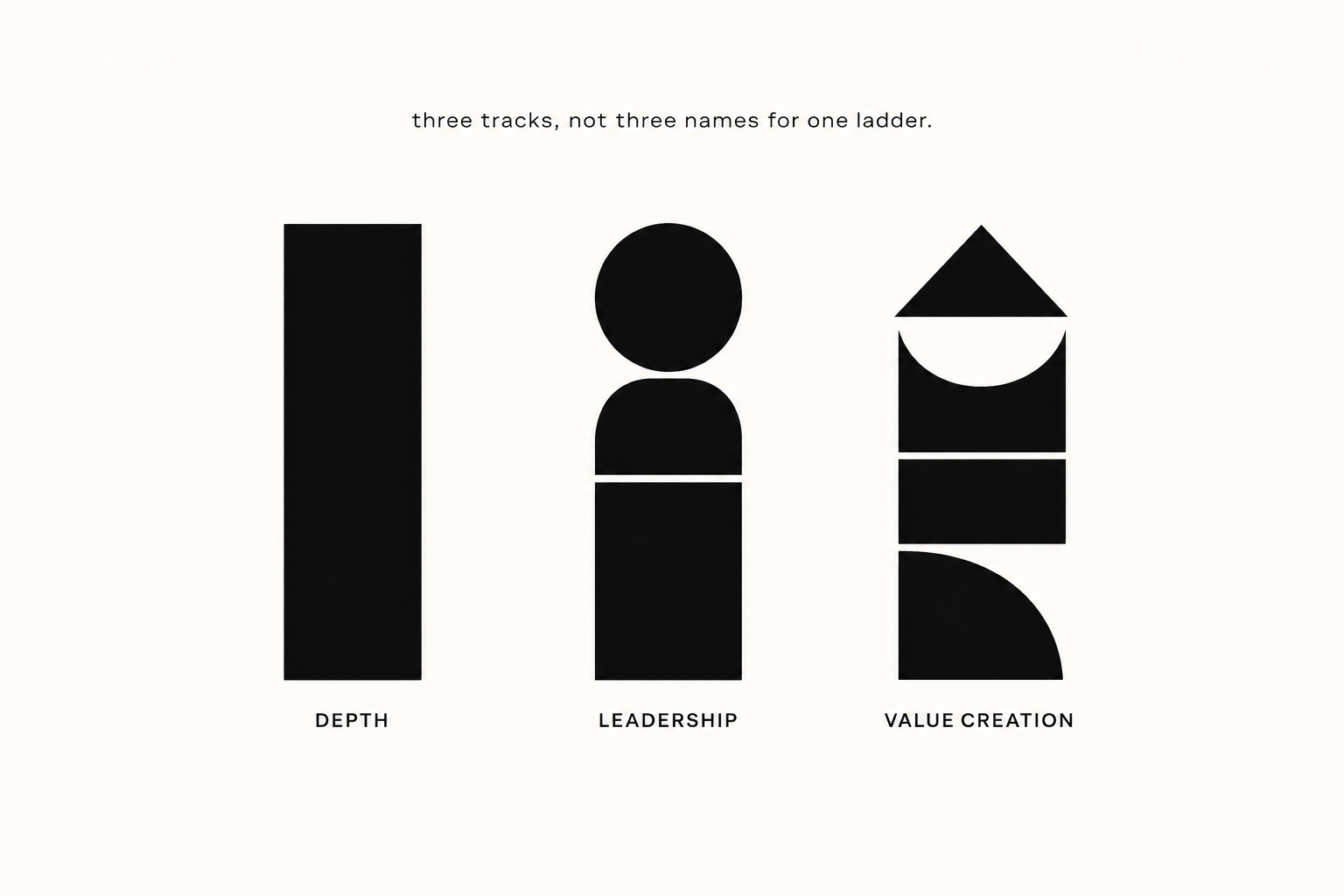
The fix is not a better title, a flatter chart, or a values statement about respecting individual contributors. Companies publish all three and change nothing, because none of them creates a destination. The distinction that actually matters is whether advancement has more than one real place to go. Not three names for the same ladder, but tracks with genuinely different criteria: one for the people who go deep and become the technical authority the company leans on, one for the people who multiply others by leading them, and one for the people who create value on their own terms, by seeing a problem no one assigned them and turning it into a product, a process, or a result the company did not have before.
That third path is the one most companies cannot quite picture, and it is also the one that changed most recently. Creating something new at any scale used to require a team, a mandate, and a place in the hierarchy senior enough to authorize it. That is no longer true. When a single motivated person can use the tools now available to turn an idea into something real, the binding constraint on initiative stops being capacity and becomes permission. The companies that notice this stop asking people to earn the right to create value through their position, and start inviting anyone, at any level, to propose the solution, build the process, or define a lane that did not exist before. The aim is not to be generous with paths. It is to stop forcing every form of excellence through the single opening that happens to be management, because most forms of excellence are not management and were never going to become it.
That is simple to write and hard to live, because it asks the company to decide in advance that depth and value creation can earn the same standing as a leadership role, and then to honor that when the review actually happens and a real promotion and a real budget are on the table. The structure is only as true as the moment it costs something. There is a phrase my co-founder and CTO, Maycon Santos, repeats so often that it has quietly become one of the principles the company runs on: generate value, and I will generate value for you. It sounded transactional to people at first, and a little hard to trust. What it means in practice is simple: the reward attaches to the value created, not to the title held or the box the work fits into. Once a team believes that and watches it get honored, people stop waiting to be told what their job is and start looking for the most valuable thing they could be doing. Good people want their contribution to be seen. A company that reliably meets created value with recognition earns more of their judgment and more of their initiative, and improves itself at a rate that a fixed hierarchy of roles cannot match.
What to Ask About Your Own Company
If you lead, the question to ask is not whether your people feel they can grow. They will tell you what you want to hear. The question is whether your advancement system has more than one destination that a capable, ambitious person would actually choose. If the only way to earn more standing and more reward is to manage, you do not have a culture problem you can talk your way out of. You have a structure that selects, every cycle, for the same narrow thing, and teaches everyone else that their kind of excellence does not count here.
This matters more now than it used to, and for the same reason the third path opened up. The people whose depth, judgment, and initiative compound are worth more to the business than at any earlier point, and the reflex to measure someone’s advancement by how many reports they have runs exactly backward. The honest return on your best builders and value creators comes from letting them keep building and creating, on a path that pays them properly for it, not from promoting them into the one role that asks them to stop. Treating a leadership title as the only thing worth investing in is, in plain terms, a misallocation of the company’s most appreciating asset.
A company that only knows how to reward leadership will keep promoting its best people out of the work it most needs them to do.


Leadership Isn’t the Only Way Up
On the Business of Building — A Column from Cynthia Jiang
Most companies have one ladder, and it runs through management. Recognizing depth and value creation as real tracks is a structural decision — not a perk.
“In most companies there is only one ladder, and almost no one chose to build it that way. It accumulated, one promotion at a time, until the only direction that counted as moving up ran through managing other people.”
By the time anyone examines it, the company has quietly decided that the reward for becoming excellent at the work is to stop doing the work.
This gets talked about as a fairness problem. It is really an allocation problem. When the single recognized path to advancement is leadership, everyone who wants to grow, and everyone you most want to keep, eventually arrives at the same choice: manage, or stall. The strongest individual contributors take the promotion, not because they want to lead, but because the alternative is watching their standing and their compensation freeze while less capable peers move past them into management. The choice is rigged, and everyone in it knows.
You Promote People Out of the Work They Are Best At
So you take your best engineer and move them into a role that rewards a completely different skill, and you do it precisely because they were good at the thing you have now asked them to stop doing. Sometimes it works. More often it produces a weaker manager and a lost specialist in a single decision, and neither loss appears on any report. What shows up instead, a quarter or two later, is a gradual thinning of the depth the company can actually draw on, and the slow departure of people who never wanted to manage and could not find another way to be valued.
The more expensive part is what the single ladder teaches everyone who is watching. It says, without ever saying it, that the work itself tops out. That past a certain level the only way the company will keep investing in you is if you stop being the person who does the work and become the person who oversees it. That is a strange thing to tell the people whose work is the reason the company exists, and they hear it clearly, even when no one says it out loud.
The Builders You Lose and the Value You Cannot Place
I have watched good companies lose their most valuable builders exactly this way, and almost never in a dramatic exit. It is quieter than that. The person who has been holding a fragile, critical part of the system together asks, in a review, what growth looks like for them, and the honest answer on offer is a management track they do not want. They stay another year. Then they take a role somewhere that has worked out how to advance a specialist, and the knowledge they were quietly carrying leaves the building with them.
There is a second pattern that costs even more, because it is harder to see. Some people create real value in shapes that fit no standard role. They unblock three teams in a week. They see the expensive mistake before it is made. They turn a vague, stuck problem into something the company can actually act on. They are not managers, and they are not always the deepest specialists, so on an org chart organized around titles and headcount they are difficult to place. Difficult to place becomes difficult to reward, and over a quarter or two they learn the lesson the structure is teaching: the surest way to be recognized here is to acquire reports. And so the company takes one of its rarest kinds of person and trains them to become one of its most common.
None of this requires anyone to act in bad faith. It is the structure doing what an unexamined structure does. A single ladder will always pull every kind of contribution toward the one shape it knows how to reward, regardless of what the company says it values.
Three Tracks, Not Three Names for One Ladder
The fix is not a better title, a flatter chart, or a values statement about respecting individual contributors. Companies publish all three and change nothing, because none of them creates a destination. The distinction that actually matters is whether advancement has more than one real place to go. Not three names for the same ladder, but tracks with genuinely different criteria: one for the people who go deep and become the technical authority the company leans on, one for the people who multiply others by leading them, and one for the people who create value on their own terms, by seeing a problem no one assigned them and turning it into a product, a process, or a result the company did not have before.
That third path is the one most companies cannot quite picture, and it is also the one that changed most recently. Creating something new at any scale used to require a team, a mandate, and a place in the hierarchy senior enough to authorize it. That is no longer true. When a single motivated person can use the tools now available to turn an idea into something real, the binding constraint on initiative stops being capacity and becomes permission. The companies that notice this stop asking people to earn the right to create value through their position, and start inviting anyone, at any level, to propose the solution, build the process, or define a lane that did not exist before. The aim is not to be generous with paths. It is to stop forcing every form of excellence through the single opening that happens to be management, because most forms of excellence are not management and were never going to become it.
That is simple to write and hard to live, because it asks the company to decide in advance that depth and value creation can earn the same standing as a leadership role, and then to honor that when the review actually happens and a real promotion and a real budget are on the table. The structure is only as true as the moment it costs something. There is a phrase my co-founder and CTO, Maycon Santos, repeats so often that it has quietly become one of the principles the company runs on: generate value, and I will generate value for you. It sounded transactional to people at first, and a little hard to trust. What it means in practice is simple: the reward attaches to the value created, not to the title held or the box the work fits into. Once a team believes that and watches it get honored, people stop waiting to be told what their job is and start looking for the most valuable thing they could be doing. Good people want their contribution to be seen. A company that reliably meets created value with recognition earns more of their judgment and more of their initiative, and improves itself at a rate that a fixed hierarchy of roles cannot match.
What to Ask About Your Own Company
If you lead, the question to ask is not whether your people feel they can grow. They will tell you what you want to hear. The question is whether your advancement system has more than one destination that a capable, ambitious person would actually choose. If the only way to earn more standing and more reward is to manage, you do not have a culture problem you can talk your way out of. You have a structure that selects, every cycle, for the same narrow thing, and teaches everyone else that their kind of excellence does not count here.
This matters more now than it used to, and for the same reason the third path opened up. The people whose depth, judgment, and initiative compound are worth more to the business than at any earlier point, and the reflex to measure someone’s advancement by how many reports they have runs exactly backward. The honest return on your best builders and value creators comes from letting them keep building and creating, on a path that pays them properly for it, not from promoting them into the one role that asks them to stop. Treating a leadership title as the only thing worth investing in is, in plain terms, a misallocation of the company’s most appreciating asset.
A company that only knows how to reward leadership will keep promoting its best people out of the work it most needs them to do.
Get new insights when we publish them
Receba novos insights quando publicarmos