The AI Productivity Paradox — Part 2 of 3
AI is sold as a way to save time. For founders, it often does the opposite — and it is worth being precise about why.
“It is late, and I have three agent sessions running at once. Each one is producing something genuinely useful.”
The feeling is not “I have done a lot today.” It is that closing any one of them would mean leaving value on the table. That feeling, not the hours, is the trap.
Work Was Never Bounded by Ambition
The first article in this series looked at how AI changes the work of individuals and teams. This one is about founders, where the same force produces a different failure.
AI is almost always introduced as a way to save time. For founders, and for anyone wired with high initiative, it often does the opposite, and it is worth being precise about why.
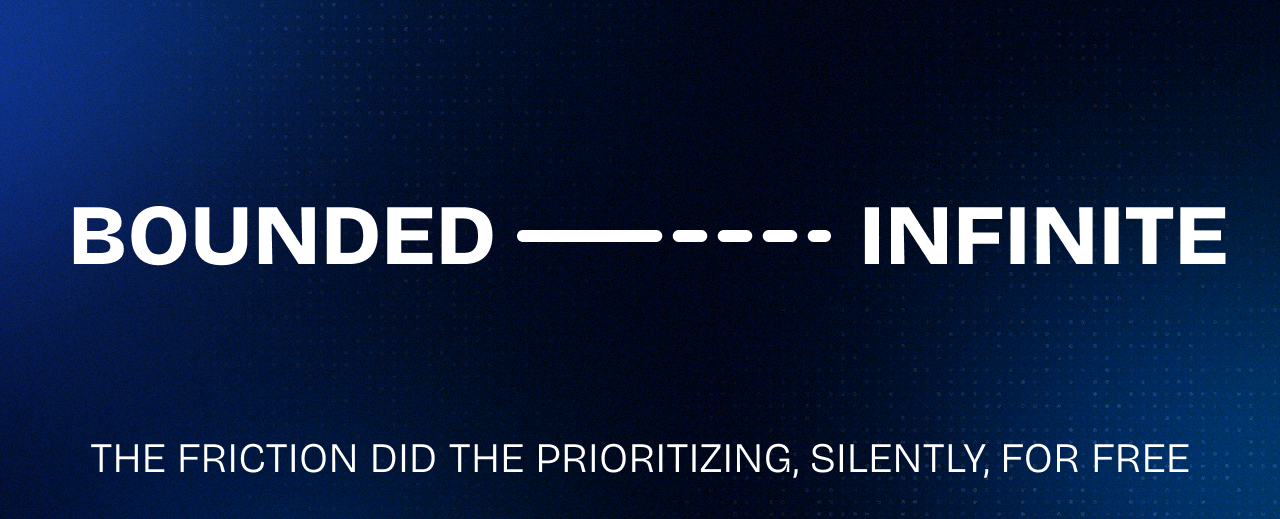
A founder’s workload was never really bounded by ambition. Ambition is effectively infinite. The workload was bounded by friction.
Every initiative, whether a new flow, a new system, or an experiment, cost enough effort to start that you were forced to choose. You could not chase all of them, so you picked. The friction did the prioritizing, silently, for free.
AI removes the friction. Not all of it, but enough to change the shape of the problem. There is always one more flow to improve, one more agent to run, one more strategy to test, one more document to refine, one more part of the business to rebuild properly.
Each of those is now cheap enough to start. So the backlog stops behaving like a list you burn down and starts behaving like a surface that expands as fast as you can work across it. The limit that used to make the decision for you, finite hours turning into finite throughput, is gone.
What replaces it is supposed to be deliberate prioritization. But deliberate prioritization rarely shows up, because everything genuinely feels achievable now, and it is hard to decline something achievable.
And there is a quiet pride in it. Taking on more than seems reasonable, and pulling it off with AI, feels like proof that you are using the moment well. Declining a workstream you could obviously run starts to feel like a failure of nerve rather than a sound decision.
Instead of reducing the work, AI makes the work feel infinite. And infinite work does not register as pressure at first. It registers as opportunity.
When Idle Capacity Starts to Feel Like Waste
I notice the pattern most clearly in how I started to read idle capacity. An agent sitting unused, an afternoon not spent building, a tool not pushed to its limit: these begin to feel like waste, like money left on the table.
That instinct is the engine of the trap. It pushes you to run workstreams in parallel, to always have one more thing in motion. And it works, in the narrow sense: personal output goes up, and the output is real.
For a while this feels like exactly what you were promised. You are shipping more, deciding faster, touching more of the company in a week than you used to touch in a month.
But there is a second effect that is harder to see from the inside. As the founder absorbs more of the leverage personally, the company gets faster and more dependent on the founder at the same time.
The speed lives in one person’s head and one person’s hands. From the outside, and often from the inside, this looks like the company scaling. It is not. It is the company running hotter. Those are different things, and the difference only becomes visible the moment the founder stops.
I have felt the early version of this myself. A week in which I personally moved a dozen things forward looks, by Friday, like the company moved a dozen things forward. It did not. I did. The distance between those two sentences is the entire problem.
The burnout that comes out of this is a particular kind. It is not the familiar burnout of scarcity: too few resources, too little time, too much asked of too little.
It is the burnout of abundance. Too much is genuinely possible, all of it is genuinely worthwhile, and there is no natural point at which the work tells you it is finished. Scarcity, at least, ends. Abundance does not.
“Scarcity ends.
Abundance does not.”
Individual Velocity Is Not Company Velocity
The obvious response to all of this is that founders need more discipline, or better boundaries. The implied answer is to learn to stop. I think that frame is wrong, and it misses the real distinction.
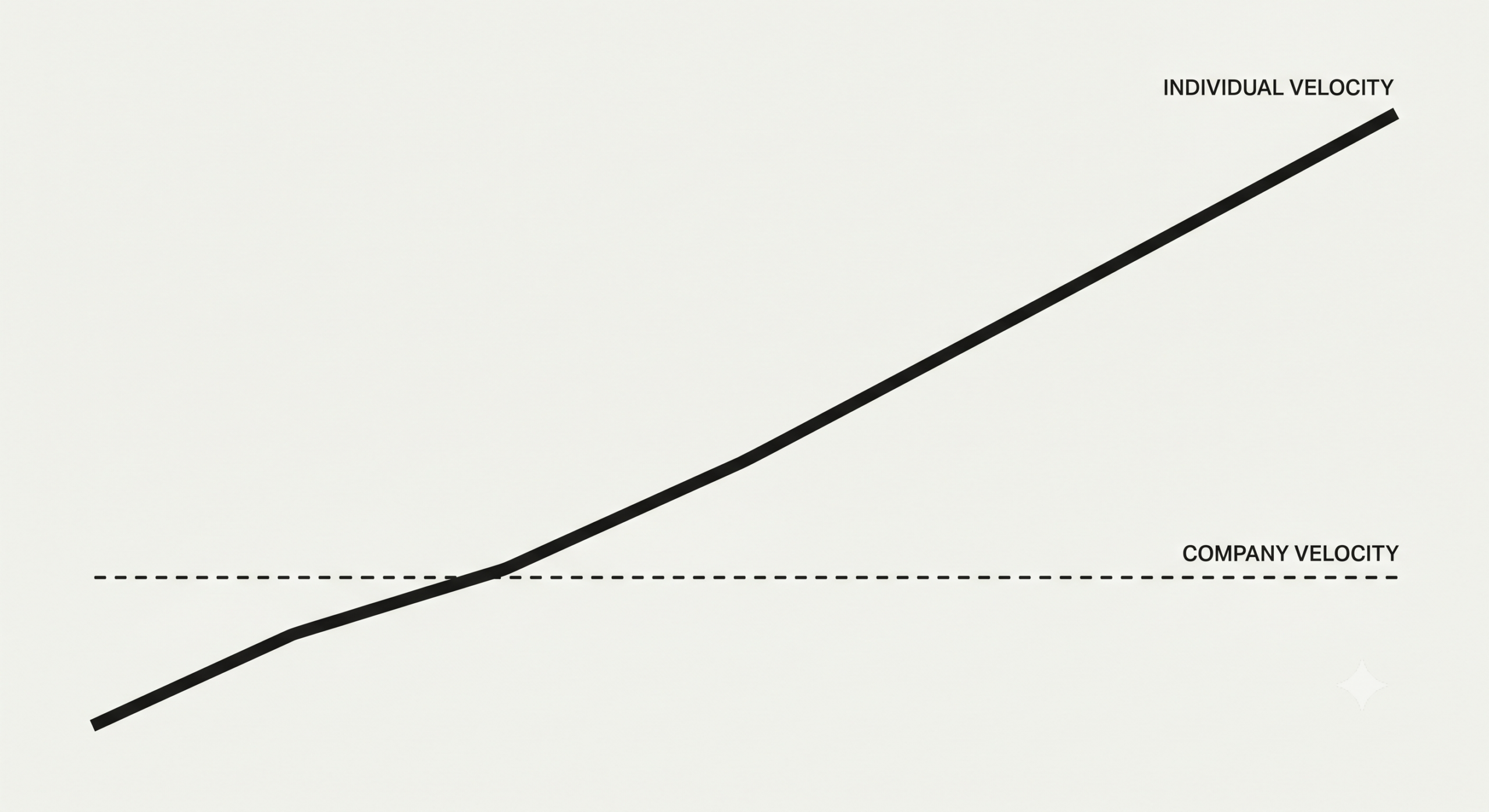
The distinction is between individual velocity and company velocity. A founder using AI to personally do more is increasing individual velocity. But company velocity, the company’s ability to deliver without that founder in the loop, can stay flat, or even fall, across exactly the same period.
The two can move in opposite directions while every visible sign points up. A founder can have their most productive quarter on record and leave the company more dependent on them than it was when the quarter started.
So the trap is not working too much. Plenty of founders work too much and still build durable companies. The trap is spending an effectively unlimited supply of AI leverage on personal throughput, when the same leverage could be spent on something that does not need you next time.
That is the real fork. The question is not “how do I work less.” It is what the leverage gets converted into: my own output, or the company’s independence from it.
Point the Leverage at the Right Question
The question worth holding onto is not “what else could I build with this.” With AI, the answer to that is always yes, and always more.
The better question is whether a given use of AI makes the company need you less or need you more. Both are possible. Pointing the leverage at the first outcome is a choice, and it is not the default. The default, the path of least resistance, is to do more yourself, faster.
Doing more yourself feels productive in the moment, and for you it genuinely is. The cost is simply deferred. It gets paid by the company later, when it discovers how much of how it runs was never written down anywhere except in the founder’s head.
This is also, for what it is worth, the more powerful use of AI, not the more modest one. Using it to encode how a decision gets made, so the decision stops routing through you; using it to turn something you do well into something the company does repeatably. That compounds.
Personal throughput does not compound. It resets every morning. A system you build once keeps returning value long after you have moved on to the next thing. The founders who get the most out of AI will not be the ones who did the most with it. They will be the ones who used it to build a company that no longer depends on their intensity to move.
A founder who spends AI only on doing more themselves builds a faster company and a more fragile one.


The Founder’s Trap: When AI Makes Work Infinite
The AI Productivity Paradox — Part 2 of 3
AI is sold as a way to save time. For founders, it often does the opposite — and it is worth being precise about why.
“It is late, and I have three agent sessions running at once. Each one is producing something genuinely useful.”
The feeling is not “I have done a lot today.” It is that closing any one of them would mean leaving value on the table. That feeling, not the hours, is the trap.
Work Was Never Bounded by Ambition
The first article in this series looked at how AI changes the work of individuals and teams. This one is about founders, where the same force produces a different failure.
AI is almost always introduced as a way to save time. For founders, and for anyone wired with high initiative, it often does the opposite, and it is worth being precise about why.
A founder’s workload was never really bounded by ambition. Ambition is effectively infinite. The workload was bounded by friction.
Every initiative, whether a new flow, a new system, or an experiment, cost enough effort to start that you were forced to choose. You could not chase all of them, so you picked. The friction did the prioritizing, silently, for free.
AI removes the friction. Not all of it, but enough to change the shape of the problem. There is always one more flow to improve, one more agent to run, one more strategy to test, one more document to refine, one more part of the business to rebuild properly.
Each of those is now cheap enough to start. So the backlog stops behaving like a list you burn down and starts behaving like a surface that expands as fast as you can work across it. The limit that used to make the decision for you, finite hours turning into finite throughput, is gone.
What replaces it is supposed to be deliberate prioritization. But deliberate prioritization rarely shows up, because everything genuinely feels achievable now, and it is hard to decline something achievable.
And there is a quiet pride in it. Taking on more than seems reasonable, and pulling it off with AI, feels like proof that you are using the moment well. Declining a workstream you could obviously run starts to feel like a failure of nerve rather than a sound decision.
Instead of reducing the work, AI makes the work feel infinite. And infinite work does not register as pressure at first. It registers as opportunity.
When Idle Capacity Starts to Feel Like Waste
I notice the pattern most clearly in how I started to read idle capacity. An agent sitting unused, an afternoon not spent building, a tool not pushed to its limit: these begin to feel like waste, like money left on the table.
That instinct is the engine of the trap. It pushes you to run workstreams in parallel, to always have one more thing in motion. And it works, in the narrow sense: personal output goes up, and the output is real.
For a while this feels like exactly what you were promised. You are shipping more, deciding faster, touching more of the company in a week than you used to touch in a month.
But there is a second effect that is harder to see from the inside. As the founder absorbs more of the leverage personally, the company gets faster and more dependent on the founder at the same time.
The speed lives in one person’s head and one person’s hands. From the outside, and often from the inside, this looks like the company scaling. It is not. It is the company running hotter. Those are different things, and the difference only becomes visible the moment the founder stops.
I have felt the early version of this myself. A week in which I personally moved a dozen things forward looks, by Friday, like the company moved a dozen things forward. It did not. I did. The distance between those two sentences is the entire problem.
The burnout that comes out of this is a particular kind. It is not the familiar burnout of scarcity: too few resources, too little time, too much asked of too little.
It is the burnout of abundance. Too much is genuinely possible, all of it is genuinely worthwhile, and there is no natural point at which the work tells you it is finished. Scarcity, at least, ends. Abundance does not.
Individual Velocity Is Not Company Velocity
The obvious response to all of this is that founders need more discipline, or better boundaries. The implied answer is to learn to stop. I think that frame is wrong, and it misses the real distinction.
The distinction is between individual velocity and company velocity. A founder using AI to personally do more is increasing individual velocity. But company velocity, the company’s ability to deliver without that founder in the loop, can stay flat, or even fall, across exactly the same period.
The two can move in opposite directions while every visible sign points up. A founder can have their most productive quarter on record and leave the company more dependent on them than it was when the quarter started.
So the trap is not working too much. Plenty of founders work too much and still build durable companies. The trap is spending an effectively unlimited supply of AI leverage on personal throughput, when the same leverage could be spent on something that does not need you next time.
That is the real fork. The question is not “how do I work less.” It is what the leverage gets converted into: my own output, or the company’s independence from it.
Point the Leverage at the Right Question
The question worth holding onto is not “what else could I build with this.” With AI, the answer to that is always yes, and always more.
The better question is whether a given use of AI makes the company need you less or need you more. Both are possible. Pointing the leverage at the first outcome is a choice, and it is not the default. The default, the path of least resistance, is to do more yourself, faster.
Doing more yourself feels productive in the moment, and for you it genuinely is. The cost is simply deferred. It gets paid by the company later, when it discovers how much of how it runs was never written down anywhere except in the founder’s head.
This is also, for what it is worth, the more powerful use of AI, not the more modest one. Using it to encode how a decision gets made, so the decision stops routing through you; using it to turn something you do well into something the company does repeatably. That compounds.
Personal throughput does not compound. It resets every morning. A system you build once keeps returning value long after you have moved on to the next thing. The founders who get the most out of AI will not be the ones who did the most with it. They will be the ones who used it to build a company that no longer depends on their intensity to move.
A founder who spends AI only on doing more themselves builds a faster company and a more fragile one.
Get new insights when we publish them
Receba novos insights quando publicarmos