The AI Productivity Paradox — Part 3 of 3
AI adoption is easy to measure. AI maturity is a different question — and it’s the one worth asking next.
“There is a slide that shows up in almost every leadership review now. AI adoption: up. Output per engineer: up. Tickets closed: up.”
The room relaxes a little. And not one number on that slide says whether the work can be trusted.
Adoption Is the Easy Thing to Measure
The first two articles in this series looked at individuals, teams, and founders. This one is for the people who lead them.
Executives are under real pressure to adopt AI, and so they measure adoption, because adoption is the easy thing to measure. Seats deployed, tools rolled out, usage rates, output per head. These numbers are available, they move in the right direction, and they are reassuring to report upward.
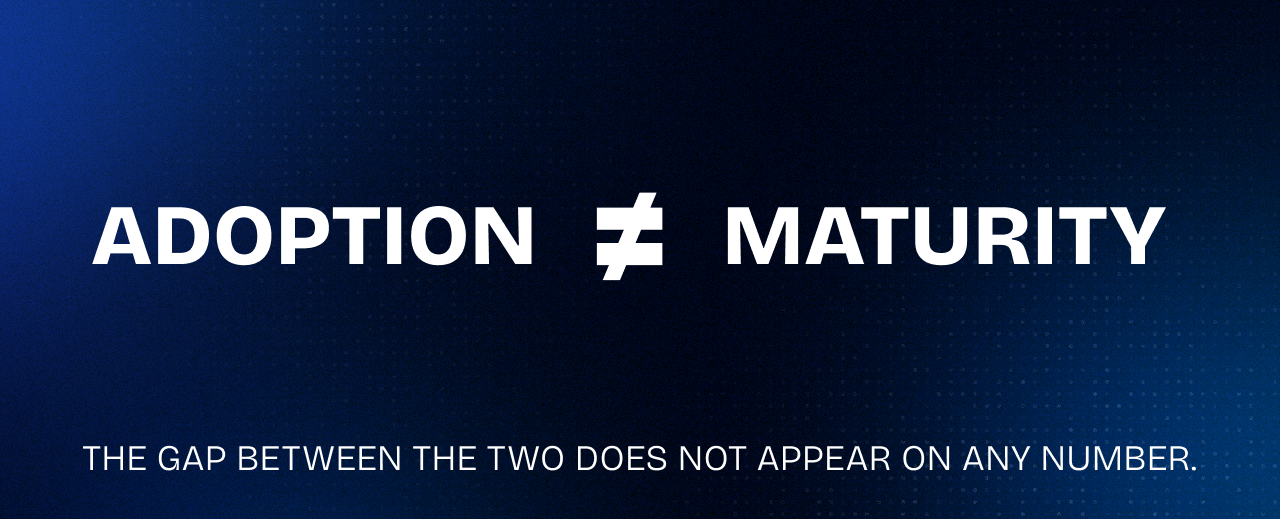
The problem is that adoption is not maturity, and the gap between the two does not appear on any of those numbers.
A company can have a dozen AI tools in active use, high engagement across every team, and a real, measurable rise in output, and still be quietly accumulating misalignment, thin validation, unclear ownership, and a steadily growing pile of rework.
Output volume is not a neutral figure. Produced without structure around it, more output means more unreviewed surface area, more decisions made implicitly rather than explicitly, more work that someone will eventually have to stop and untangle.
The dashboard climbs while the underlying risk profile gets worse, and nothing forces those two facts into the same view.
For most of the history of software, output and risk at least moved together loosely. Producing more meant more people had touched the work, discussed it, pushed back on it along the way. AI broke that coupling. Output can now rise without any of that happening, which means the output number has quietly lost most of its value as a signal of how healthy the work is.
So here is a question that has quietly stopped being useful: are our teams using AI? It is already answered. The answer is yes, almost everywhere, and it tells you very little about whether AI is actually helping. A better question has to take its place.
The Question That Gets a Softer Answer
I find the gap easy to surface in a single conversation. Ask a leadership team whether their engineers are using AI, and you get an immediate, confident yes, usually with examples.
Ask the next set of questions. How is AI-assisted work reviewed? What does someone actually sign off on? How do you know that what was delivered matches what was asked for? The answers get noticeably softer.
This is not a story about bad teams. It is usually the opposite: capable teams who adopted AI quickly and well, and whose tooling simply outran the process meant to govern it. The enthusiasm was real. The structure just did not scale at the same speed.
The output is real, too; I want to be clear about that. The code exists, the documents exist, the analysis exists. What is often missing is the chain that would make that output trustworthy: the part that establishes not just that work was produced, but that it was the right work, understood, and verified.
In practice the missing link is rarely dramatic. It is a scope that was assumed rather than agreed, an owner who was never quite named, a review that confirmed the code worked but never asked whether it was the right thing to build. Each gap on its own is small. They become expensive only in aggregate, and only later.
The cost of a missing trust chain is patient. It does not arrive as a visible failure. It arrives a quarter or two later: as rework, as a missed assumption surfacing in production, as a delivery that does not match what a stakeholder believed had been agreed.
Because that cost is separated in time from the output spike that produced it, leadership rarely connects the two. The quarter of high output and the later quarter of heavy rework look like unrelated events. They are not. Across enough quarters the pattern compounds: the organization moves faster and trusts its own delivery less, without ever seeing a single moment where that trade was made.
“Adoption is a decision.
Maturity is a structure.”
A Governance Problem, Not a Measurement Problem
The common correction here is “measure outcomes, not output,” tracking business results instead of activity. That is true, and it is still not the heart of it.
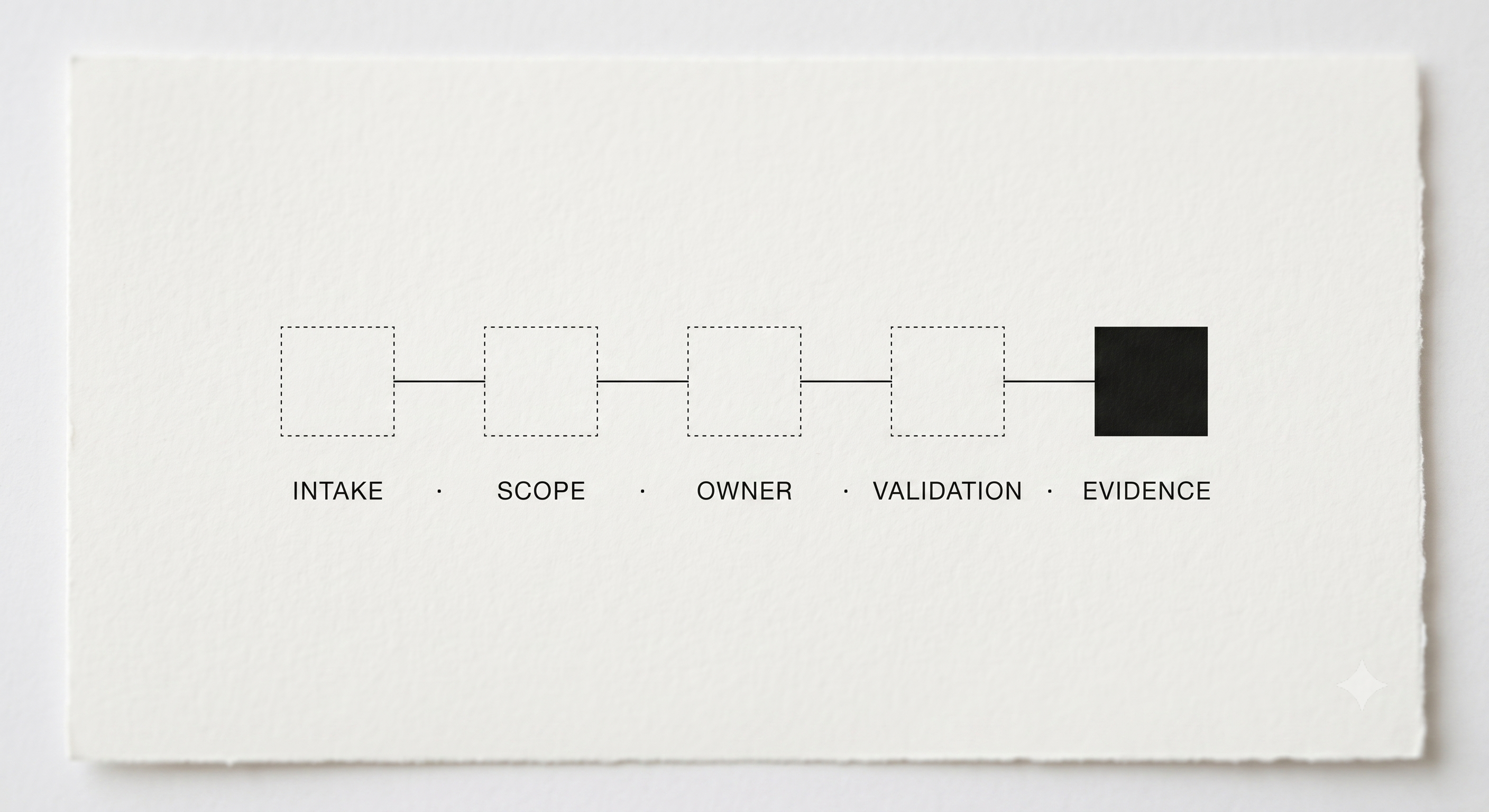
The heart of it is that this is not, at root, a measurement problem. It is a governance problem. The question is not which number goes on the slide. The question is whether AI-assisted work passes through a structure that makes it trustworthy: a clear intake, an agreed scope, explicit ownership, a real validation step, and evidence that what was delivered matches what was approved.
That reframes what AI maturity actually is. Adoption is a tooling decision; you can buy it, and most organizations already have. Maturity is a structural one. You do not get from one to the other by using the tools more, or more enthusiastically. You get there by building the structure that governs what the tools produce.
None of this is exotic. Clear intake, agreed scope, ownership, validation, evidence: these are old ideas. What is new is the stakes attached to them. They used to be nice-to-haves that a capable team could improvise around. They are now the difference between AI that compounds value and AI that compounds risk.
The Question to Put to Your Organization
For a leader, the practical shift is in the question you put to your own organization. Not “are our teams using AI.” That question is spent, and its answer told you nothing about risk.
Ask instead: can we trust what AI is helping our teams produce, and what specifically would we point to as proof? If the answer is a defined intake, a named owner, a validation step, an evidence trail, that is maturity, and it is worth more than any output number on any slide. If the answer is the output number itself, then the slide is not telling the room what the room thinks it is.
None of this is a reason to slow down on AI. It is a reason to be precise about what progress means. Output going up is not progress; it is activity, and activity is easy. Progress is output you can trust, delivered through a structure that makes that trust legible to the people accountable for it.
For a leadership audience that distinction is not academic. It is the difference between an AI investment that shows up as durable capability and one that shows up, a few quarters on, as a cleanup cost nobody forecast.
Building that structure is the actual work of AI maturity. It is also what finally lets output and progress point in the same direction, which was the entire promise of adopting AI in the first place.
AI adoption is not AI maturity, and no amount of output will carry an organization across the distance between them.

Maycon Santos Co-founder & CTO at Inventeer Technologies, real proof of The Founders Trap. Still Working at a Saturday 9:16 PM.


More Output Doesn’t Mean More Progress: A Conversation with Leaders About AI Productivity
The AI Productivity Paradox — Part 3 of 3
AI adoption is easy to measure. AI maturity is a different question — and it’s the one worth asking next.
“There is a slide that shows up in almost every leadership review now. AI adoption: up. Output per engineer: up. Tickets closed: up.”
The room relaxes a little. And not one number on that slide says whether the work can be trusted.
Adoption Is the Easy Thing to Measure
The first two articles in this series looked at individuals, teams, and founders. This one is for the people who lead them.
Executives are under real pressure to adopt AI, and so they measure adoption, because adoption is the easy thing to measure. Seats deployed, tools rolled out, usage rates, output per head. These numbers are available, they move in the right direction, and they are reassuring to report upward.
The problem is that adoption is not maturity, and the gap between the two does not appear on any of those numbers.
A company can have a dozen AI tools in active use, high engagement across every team, and a real, measurable rise in output, and still be quietly accumulating misalignment, thin validation, unclear ownership, and a steadily growing pile of rework.
Output volume is not a neutral figure. Produced without structure around it, more output means more unreviewed surface area, more decisions made implicitly rather than explicitly, more work that someone will eventually have to stop and untangle.
The dashboard climbs while the underlying risk profile gets worse, and nothing forces those two facts into the same view.
For most of the history of software, output and risk at least moved together loosely. Producing more meant more people had touched the work, discussed it, pushed back on it along the way. AI broke that coupling. Output can now rise without any of that happening, which means the output number has quietly lost most of its value as a signal of how healthy the work is.
So here is a question that has quietly stopped being useful: are our teams using AI? It is already answered. The answer is yes, almost everywhere, and it tells you very little about whether AI is actually helping. A better question has to take its place.
The Question That Gets a Softer Answer
I find the gap easy to surface in a single conversation. Ask a leadership team whether their engineers are using AI, and you get an immediate, confident yes, usually with examples.
Ask the next set of questions. How is AI-assisted work reviewed? What does someone actually sign off on? How do you know that what was delivered matches what was asked for? The answers get noticeably softer.
This is not a story about bad teams. It is usually the opposite: capable teams who adopted AI quickly and well, and whose tooling simply outran the process meant to govern it. The enthusiasm was real. The structure just did not scale at the same speed.
The output is real, too; I want to be clear about that. The code exists, the documents exist, the analysis exists. What is often missing is the chain that would make that output trustworthy: the part that establishes not just that work was produced, but that it was the right work, understood, and verified.
In practice the missing link is rarely dramatic. It is a scope that was assumed rather than agreed, an owner who was never quite named, a review that confirmed the code worked but never asked whether it was the right thing to build. Each gap on its own is small. They become expensive only in aggregate, and only later.
The cost of a missing trust chain is patient. It does not arrive as a visible failure. It arrives a quarter or two later: as rework, as a missed assumption surfacing in production, as a delivery that does not match what a stakeholder believed had been agreed.
Because that cost is separated in time from the output spike that produced it, leadership rarely connects the two. The quarter of high output and the later quarter of heavy rework look like unrelated events. They are not. Across enough quarters the pattern compounds: the organization moves faster and trusts its own delivery less, without ever seeing a single moment where that trade was made.
A Governance Problem, Not a Measurement Problem
The common correction here is “measure outcomes, not output,” tracking business results instead of activity. That is true, and it is still not the heart of it.
The heart of it is that this is not, at root, a measurement problem. It is a governance problem. The question is not which number goes on the slide. The question is whether AI-assisted work passes through a structure that makes it trustworthy: a clear intake, an agreed scope, explicit ownership, a real validation step, and evidence that what was delivered matches what was approved.
That reframes what AI maturity actually is. Adoption is a tooling decision; you can buy it, and most organizations already have. Maturity is a structural one. You do not get from one to the other by using the tools more, or more enthusiastically. You get there by building the structure that governs what the tools produce.
None of this is exotic. Clear intake, agreed scope, ownership, validation, evidence: these are old ideas. What is new is the stakes attached to them. They used to be nice-to-haves that a capable team could improvise around. They are now the difference between AI that compounds value and AI that compounds risk.
The Question to Put to Your Organization
For a leader, the practical shift is in the question you put to your own organization. Not “are our teams using AI.” That question is spent, and its answer told you nothing about risk.
Ask instead: can we trust what AI is helping our teams produce, and what specifically would we point to as proof? If the answer is a defined intake, a named owner, a validation step, an evidence trail, that is maturity, and it is worth more than any output number on any slide. If the answer is the output number itself, then the slide is not telling the room what the room thinks it is.
None of this is a reason to slow down on AI. It is a reason to be precise about what progress means. Output going up is not progress; it is activity, and activity is easy. Progress is output you can trust, delivered through a structure that makes that trust legible to the people accountable for it.
For a leadership audience that distinction is not academic. It is the difference between an AI investment that shows up as durable capability and one that shows up, a few quarters on, as a cleanup cost nobody forecast.
Building that structure is the actual work of AI maturity. It is also what finally lets output and progress point in the same direction, which was the entire promise of adopting AI in the first place.
AI adoption is not AI maturity, and no amount of output will carry an organization across the distance between them.
Maycon Santos Co-founder & CTO at Inventeer Technologies, real proof of The Founders Trap. Still Working at a Saturday 9:16 PM.
Get new insights when we publish them
Receba novos insights quando publicarmos